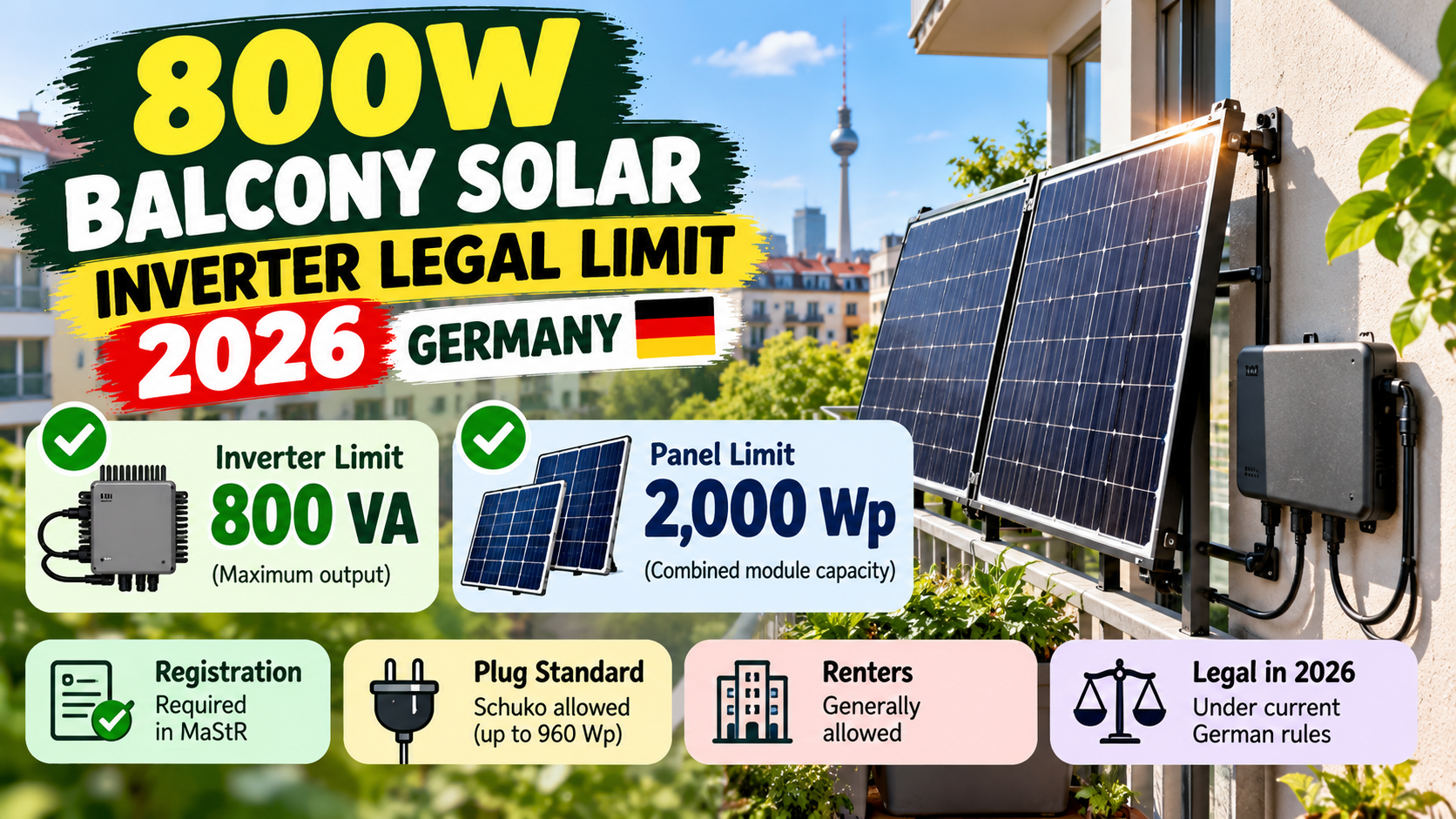
800W Balcony Solar Inverter Legal Limit 2026: Germany
Balcony solar explained
800W Balcony Solar Inverter Legal Limit in 2026: What You Need to Know
Planning to install a plug-in solar system on your balcony? In Germany, the simplified rules for a typical Balkonkraftwerk allow an inverter with a maximum rated output of 800 watts (800 VA) and solar modules with a combined installed capacity of up to 2,000 watts peak (Wp). The inverter limit is not the same as the panel limit—and registration, plug standards and safe mounting still matter.

1. What is the legal 800W balcony solar inverter limit in Germany?
As of 29 October 2026, Germany’s simplified legal framework for plug-in solar devices applies to systems with a combined module capacity of no more than 2 kWp and a combined inverter rated output of no more than 800 volt-amperes (VA). In everyday product descriptions, that inverter limit is commonly written as 800W AC.
The limit relates to the inverter’s rated output to the household electrical system—not to the maximum power printed on the solar panels. The legal basis is Section 8(5a) of Germany’s Renewable Energy Sources Act (EEG), with practical guidance published by the Federal Network Agency.
2. Can solar panels exceed 800W?
Yes. The panels’ combined rated DC capacity can be higher than the inverter’s AC output. Under Germany’s simplified plug-in solar rules, the combined installed panel capacity can be up to 2,000 Wp while the inverter output remains at or below 800 VA.
For example, two 450Wp modules provide 900Wp of panel capacity. If paired with a compliant 800VA inverter, their combined module rating is under the 2,000Wp cap. The actual power produced varies with sunshine, panel angle, shading, temperature and system design; the system does not generate its nameplate maximum all day.
| Specification | Simplified plug-in solar limit in Germany | What to check |
|---|---|---|
| Solar module capacity (DC) | Up to 2,000 Wp combined | Add the rated peak watts of every module in the system. |
| Inverter rated output (AC) | Up to 800 VA combined | Use the maximum rated/selectable output on the inverter label or certificate—not an app’s temporary limit. |
| More than one plug-in system | Combine systems at the same consumer supply point | Do not assume separate balconies or devices create separate limits; the combined values matter. |
If your planned system exceeds either threshold, that does not automatically mean solar panels are forbidden. It means you cannot rely on the simplified plug-in solar provisions for that configuration; normal grid-connection, registration and electrical installation requirements may apply. Consult a qualified electrician and your network operator before connecting a larger system.
3. Do you need to register an 800W balcony solar inverter in 2026?
Yes. A qualifying plug-in solar system must be registered in Germany’s Marktstammdatenregister (Market Master Data Register, or MaStR). The general registration deadline is within one month of commissioning. Use the official MaStR website and have the module and inverter details available.
For systems within the simplified legal limits that use the standard unpaid-surplus arrangement, a separate registration with the grid operator is generally no longer required. The register passes the relevant information on automatically. You do not normally need to wait for a potentially necessary meter change before operating a qualifying system; the meter operator handles any required replacement.
- Register the system in the MaStR within one month after first commissioning.
- Record the actual module capacity and the inverter’s maximum rated output accurately.
- Do not assume registration is optional because the system is small or produces little surplus.
- If you want payment for exported electricity or your system exceeds the simplified limits, check the requirements for the regular PV process.
4. Can you use a normal Schuko plug in 2026?
For Germany, the answer depends on the equipment and its compliance with the relevant technical standards. The product standard DIN VDE V 0126-95 for plug-in solar systems without storage has applied since 1 December 2025, according to the consumer advice centres and the Federal Environment Agency.
A standard household Schuko connection may be norm-compliant when the device meets the product standard, includes the required protective measures and the module capacity does not exceed 960W. For module capacity above 960W, the published guidance says a dedicated feed-in socket (for example, a Wieland connection) or a fixed connection installed by an electrician is required for a standards-compliant connection.
The 960W figure is a technical connection rule associated with the applicable product standard—not a replacement for the separate 800VA inverter output limit or the 2,000Wp panel limit.
5. What about renters, landlords and apartment buildings?
German tenancy law treats plug-in solar systems as a privileged type of tenant improvement, but that does not mean every mounting method can be used without coordination. Section 554 of the German Civil Code (BGB) allows tenants to request permission for certain structural changes for electricity generation using plug-in solar devices, subject to the statutory balancing of interests.
Before drilling, changing the balcony façade or attaching a panel to a railing, submit a clear proposal to your landlord or property manager and check the building’s rules. Owners in a condominium should also check the relevant owners’ association process. Approval may depend on the proposed mounting, building appearance, heritage protection, safety and other case-specific factors.
Mounting safety is just as important as electrical compliance. The frame must be suitable for the balcony, and brackets must withstand wind loads. Do not obstruct escape routes, create falling-object hazards or install a system where it could endanger people below. Check any local building or heritage requirements before fitting panels.
6. Checklist before connecting an 800W balcony solar kit
- ☐ Confirm the rules apply in Germany and check whether your configuration qualifies for the simplified category.
- ☐ Verify total module capacity is at most 2,000Wp and total inverter rated output is at most 800VA.
- ☐ Check the inverter’s nameplate/certificate and do not rely on a software-only power limit.
- ☐ Look for compliance with the applicable grid-connection and product standards, including DIN VDE V 0126-95 where relevant.
- ☐ Use the correct plug/connection for module capacity and equipment safety features; get professional advice if unsure.
- ☐ Secure modules against wind and follow the mounting manufacturer’s instructions.
- ☐ Coordinate with the landlord or building owner before making structural changes.
- ☐ Register the system in the MaStR within one month of commissioning.
Why does the 800W limit matter?
Balcony solar systems are primarily intended to reduce the electricity a household buys from the grid by producing power when appliances are running. A panel setup may be rated above 800Wp, but the inverter cap limits the maximum AC power it can feed into the household circuit under the simplified rules. That can be useful when sunlight is variable, though the best size depends on your daytime electricity use, available balcony space, orientation and shading.
Do not buy a kit based only on a headline saying “800W”. Check the panel rating, inverter’s maximum certified output, connector type, safety documentation, mounting hardware and what the vendor says about the standards applicable in Germany.
Frequently asked questions
Is an 800W balcony solar inverter legal in Germany in 2026?
Yes, qualifying plug-in solar systems can use an inverter with rated output up to 800VA under Germany’s simplified framework, provided the combined module capacity is no more than 2,000Wp and the other conditions are met.
Can I connect 1,000W or 1,600W of solar panels to an 800W inverter?
Panel capacity can exceed the inverter output, up to the 2,000Wp simplified-category cap. The complete system and connection still need to comply with the applicable standards; note the separate Schuko connection threshold of 960W module capacity.
Can I install two 800W inverters on different balconies?
Do not assume each balcony receives a separate allowance. The simplified limits add up all qualifying plug-in solar systems behind the same consumer supply point; a combined inverter output above 800VA is outside the simplified category.
Do I need to tell my electricity grid operator?
For a qualifying system within the simplified legal thresholds and using the required unpaid-surplus arrangement, a separate notification to the grid operator is generally not required. Registration in the MaStR remains required.
Can I plug any balcony solar inverter into a Schuko socket?
No. The device must meet applicable standards and protective requirements, and the published 2026 guidance limits norm-compliant Schuko use to systems with no more than 960W of module capacity. Higher module capacity requires an appropriate dedicated feed-in socket or fixed connection installed by an electrician.
Can a landlord stop me from installing balcony solar?
German law gives tenants a route to request permission for a plug-in solar installation, but the proposed structural change can still be assessed under the law. Get approval for the proposed mounting and check applicable building, safety and condominium rules before installing.
What if my inverter can output 900W but I limit it in the app to 800W?
The Federal Network Agency says the maximum selectable output is what matters; software limiting does not make a higher-rated inverter eligible for the 800VA simplified category. Choose a compliant device or get professional advice on the regular installation route.
Bottom line
For Germany in 2026, remember the three headline numbers: 800VA inverter output, 2,000Wp module capacity and 960W as the cited Schuko-connection threshold under the relevant product standard. Register your setup in the MaStR, mount panels securely, and verify the exact equipment and building requirements before connecting it.
Official and expert sources
- German Federal Network Agency: Balcony solar systems — statutory wattage thresholds, cumulative limits and rating guidance.
- Renewable Energy Sources Act (EEG), Section 8(5a) — legal basis for 2kW module capacity and 800VA inverter output within the simplified framework.
- German Environment Agency: Plug-in solar devices — technical standards, 960W Schuko connection threshold and safe installation information.
- Verbraucherzentrale: Plug-in solar directly from the balcony — consumer guidance on the applicable product standard and connection types.
- German Federal Network Agency: Registration requirements — MaStR registration deadline and grid operator notification information.
- German Civil Code (BGB), Section 554 — tenants’ request for permission for certain structural changes including plug-in solar devices.
Disclaimer: This article is general information, not legal or electrical advice. Rules, technical standards and building-specific requirements may change. Confirm the current requirements with official German sources and a qualified professional before installation.