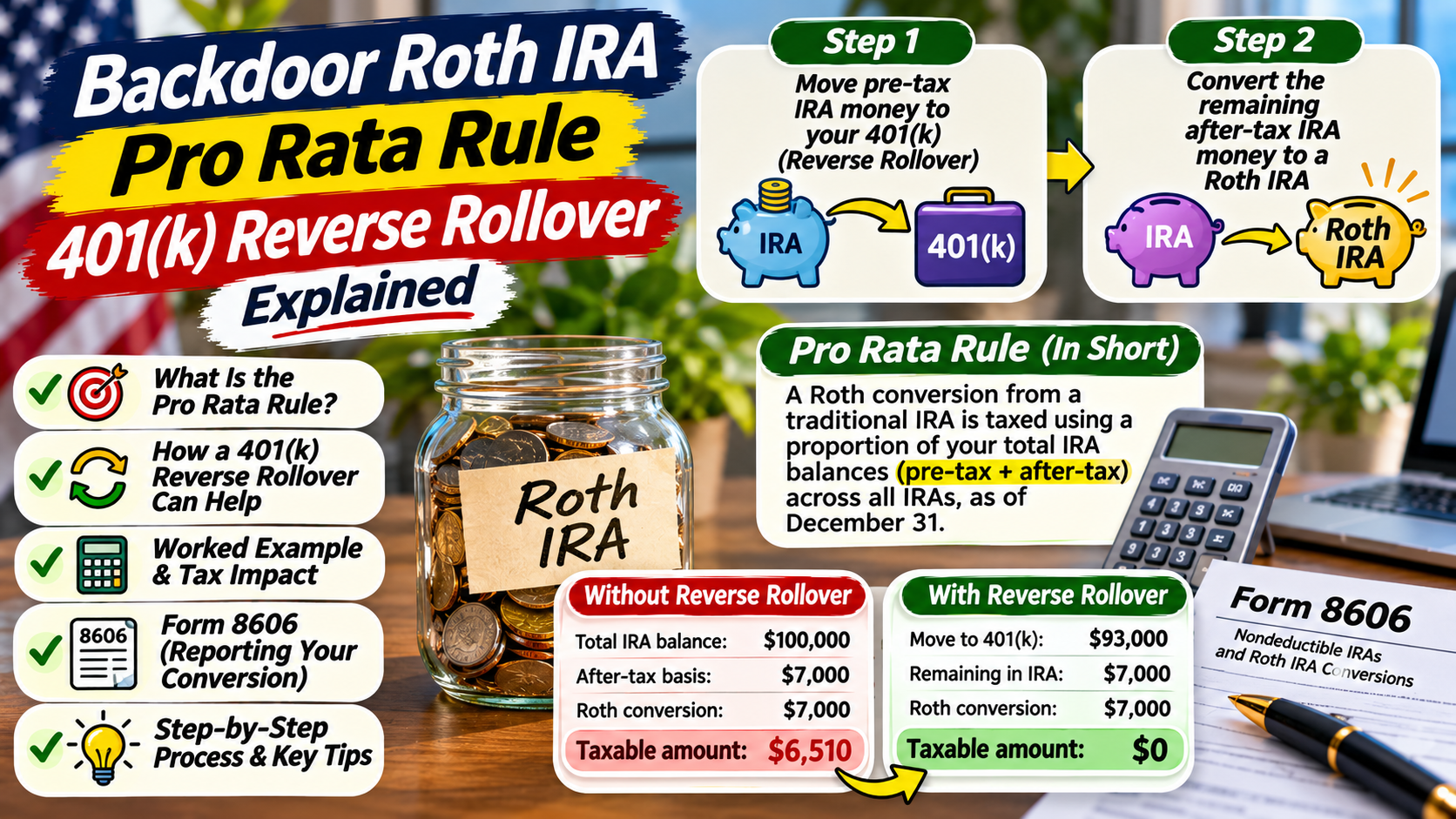
Backdoor Roth IRA Pro Rata Rule: 401(k) Reverse Rollover
Backdoor Roth IRA Pro Rata Rule: How a 401(k) Reverse Rollover Works
A backdoor Roth conversion can create an unexpected tax bill when you own pre-tax money in traditional, SEP, or SIMPLE IRAs. Learn how the pro rata rule works, how Form 8606 calculates the taxable portion, and when moving eligible pre-tax IRA dollars into a 401(k) may help.
1. What is the backdoor Roth IRA pro rata rule?
A backdoor Roth IRA is a strategy in which a person makes a nondeductible contribution to a traditional IRA and then converts that money to a Roth IRA. It is commonly used by people whose income is too high to make a direct Roth IRA contribution.
The complication is that the IRS does not let you simply label the dollars being converted as “after-tax contributions” while leaving all pre-tax IRA dollars untouched. Instead, the taxable and nontaxable portions are generally calculated proportionally across your traditional IRA pool. This is commonly called the pro rata rule.
In practical terms, if you have a large pre-tax traditional IRA, SEP IRA, or SIMPLE IRA balance, only a small fraction of a backdoor Roth conversion may be tax-free—even when the contribution you just made was entirely nondeductible.
2. Which accounts count toward the pro rata rule?
For the Form 8606 calculation, the IRS generally treats traditional IRAs as including traditional SEP IRAs and traditional SIMPLE IRAs unless a specific exception applies. The 2025 Form 8606 itself states this in its instructions. See the IRS Form 8606 (PDF).
Your spouse’s IRAs are not combined with yours for this calculation. Each spouse determines their own IRA basis and generally files a separate Form 8606 when required. The IRS form has separate taxpayer identification fields for each spouse.
3. How Form 8606 calculates the taxable amount
Form 8606 tracks your nondeductible contributions and the remaining after-tax basis in traditional IRAs. When you take an IRA distribution or make a Roth conversion, the form uses a ratio to determine the nontaxable share.
In the 2025 Form 8606, the calculation uses:
- Line 5: your adjusted basis available for the calculation;
- Line 6: the value of all traditional IRAs on December 31, plus applicable outstanding rollovers;
- Line 7: certain traditional IRA distributions, excluding Roth conversions and qualifying rollovers; and
- Line 8: the net amount converted from traditional IRAs to Roth IRAs.
IRA basis ÷ (December 31 IRA value + reportable IRA distributions + Roth conversions)Nontaxable share of the conversion
Roth conversion amount × pro rata percentageTaxable share of the conversion
Roth conversion amount − nontaxable shareThis reflects the structure of the IRS Form 8606 calculation: line 9 adds lines 6, 7, and 8; line 10 divides basis by that total; and line 11 applies the percentage to the Roth conversion. Review lines 6–11 on the official form.
The December 31 value matters. A 401(k) balance is not added to the traditional IRA denominator. That distinction is why a qualifying reverse rollover can be relevant to a backdoor Roth strategy.
Interactive backdoor Roth pro rata calculator
Enter your own illustrative figures to estimate the nontaxable and taxable portions of a conversion. Use the year-end value of all your traditional, SEP, and SIMPLE IRAs—not just the account used for the conversion.
Illustrative result only. Your actual Form 8606 may require additional adjustments or worksheets.
4. Worked example: before and after a reverse rollover
Consider a simplified example. Assume you have $7,000 of documented after-tax basis and $100,000 across your traditional IRA accounts. You convert $7,000 to a Roth IRA. Assume no other distributions, no investment movement, and no other adjustments.
Scenario A: You do not move the pre-tax IRA money
After the $7,000 conversion, you have $93,000 left in traditional IRAs at year-end. For the simplified Form 8606 ratio, the denominator is $93,000 of year-end IRA value plus the $7,000 conversion, or $100,000. The nontaxable percentage is $7,000 ÷ $100,000 = 7%.
| Item | Illustrative amount |
|---|---|
| After-tax IRA basis | $7,000 |
| December 31 IRA value | $93,000 |
| Roth conversion | $7,000 |
| Nontaxable share of conversion (7%) | $490 |
| Taxable share of conversion | $6,510 |
Scenario B: The 401(k) accepts the eligible pre-tax amount
Now assume your 401(k) plan accepts rollovers from traditional IRAs. Under the IRS special rule, a qualifying IRA-to-plan rollover can be treated as coming from the otherwise taxable portion if the amount left in your IRAs (or not rolled over) is at least equal to your IRA basis. In this simplified example, $93,000 of pre-tax IRA money is rolled into the 401(k), leaving $7,000 of basis in the IRA. You then convert that remaining $7,000 to a Roth IRA.
If the reverse rollover and conversion are completed correctly and no other traditional, SEP, or SIMPLE IRA balances remain at December 31, the simplified denominator is $7,000 (the conversion), and the basis is $7,000. The conversion is therefore 100% nontaxable in this example.
| Item | Illustrative amount |
|---|---|
| Pre-tax amount moved to 401(k) | $93,000 |
| After-tax basis left in IRA | $7,000 |
| Roth conversion | $7,000 |
| December 31 traditional IRA value (after conversion) | $0 |
| Nontaxable share of conversion | $7,000 |
| Taxable share of conversion | $0 |
5. How a 401(k) reverse rollover works
A reverse rollover is the movement of eligible money from a traditional IRA into an employer-sponsored retirement plan, such as a 401(k). It is the reverse of the more familiar rollover that moves money from an old 401(k) into an IRA.
The IRS permits a traditional IRA distribution to be rolled into a qualified employer plan, but the plan is not required to accept it. The IRS explains that the rollover can generally include only the part that would otherwise be taxable. See IRS Publication 590-A, “Kinds of rollovers from a traditional IRA”, and the IRS IRA rollover FAQs.
That is the key planning point: if you have after-tax basis, you generally cannot simply transfer that nontaxable basis into a traditional 401(k). The IRS special rule allows the eligible plan rollover to be treated as consisting only of otherwise taxable dollars when the amount you leave in the IRA pool is at least as large as your basis. In a typical clean-up strategy, eligible pre-tax dollars are moved to the plan while the after-tax basis remains in the IRA to be converted or carried forward.
6. Step-by-step checklist before attempting a reverse rollover
- List every IRA you own. Include traditional IRAs at every brokerage, traditional SEP IRAs, and traditional SIMPLE IRAs. Record current balances and check your prior Forms 8606 for basis.
- Ask the 401(k) administrator whether IRA roll-ins are accepted. Ask whether the plan accepts incoming rollovers from traditional IRAs, what documentation is required, which assets are eligible, whether the money must be liquidated to cash, and how the transfer should be initiated.
- Confirm the eligible pre-tax amount. Work out the amount that can be rolled into the employer plan without attempting to transfer after-tax basis. If you have nondeductible contributions, tell the plan administrator and tax professional before initiating the transaction.
- Use the plan’s approved transfer process. A direct trustee-to-trustee transfer is often preferable to having a check made payable to you. Follow the receiving plan’s instructions and retain confirmation from both custodians.
- Convert or retain the remaining IRA basis deliberately. If you intend to convert it, confirm that the amount remaining is consistent with your documented basis and that no other traditional, SEP, or SIMPLE IRA balances will affect the year-end calculation.
- Check the December 31 balances. Form 8606 generally uses the year-end value of all traditional IRAs, plus specified distributions and conversions for that tax year. Do not rely only on the balance on the day you made the conversion.
- File Form 8606 and keep the records. Report nondeductible contributions, the conversion, and any IRA-to-plan rollover as required. Keep Forms 8606, Forms 1099-R, plan confirmations, and year-end IRA statements.
7. Important restrictions and risks
Your 401(k) can say no
Even though the tax rules may permit an IRA-to-plan rollover, a 401(k) plan does not have to accept it. The plan document and administrator control whether incoming IRA rollovers are allowed. Get confirmation before you move money.
Only eligible taxable IRA dollars can generally move into the plan
The special rule is designed to let the rollover consist of otherwise taxable amounts when at least the amount of your IRA basis remains outside the plan. Do not assume you can roll your entire IRA into a 401(k) if it contains nondeductible basis.
SIMPLE IRA two-year restriction
Special restrictions apply to SIMPLE IRAs. In general, a SIMPLE IRA cannot be rolled into a different type of IRA or an employer plan during the two-year period beginning when you first participated in the SIMPLE IRA plan. Check the date and applicable rules before moving SIMPLE IRA money. See IRS Publication 590-A.
Compare the 401(k) before moving money
A reverse rollover can simplify the IRA tax calculation, but it may move assets into a plan with different investment choices, fees, withdrawal rules, and services. Review the plan’s investment menu, costs, and distribution provisions. Do not move money solely for the tax calculation without checking the plan itself.
Do not lose track of your IRA basis
Form 8606 is the record of nondeductible basis. Keep copies of every filed form. If you made nondeductible IRA contributions in earlier years but did not file Form 8606 when required, discuss how to correct the reporting with a qualified tax professional before converting.
A Roth conversion cannot simply be undone
Roth conversions made after 2017 generally cannot be recharacterized back to a traditional IRA. Confirm the tax impact before converting. The IRS explains this rule in its IRA rollover and conversion FAQs.
8. Reverse rollover versus other ways to handle the pro rata rule
| Approach | Potential benefit | What to consider |
|---|---|---|
| Reverse-roll eligible pre-tax IRA money into a 401(k) | May reduce the traditional IRA balance included in the year-end Form 8606 calculation. | Plan must accept the rollover; only eligible taxable amounts can generally be moved; plan fees and investments matter. |
| Convert the full pre-tax IRA balance to a Roth IRA | Can eliminate pre-tax traditional IRA balances after conversion. | The taxable amount may be large and could push income into a higher tax bracket or affect other tax calculations. |
| Leave the nondeductible basis in the traditional IRA | Can defer a conversion until a more suitable year or until the IRA balance situation changes. | Basis remains subject to future Form 8606 calculations; keep records and account for future growth. |
| Skip or delay the backdoor Roth contribution/conversion | Avoids an immediate conversion decision while you review options. | Consider eligibility for direct Roth contributions and other retirement-saving routes. |
Frequently asked questions
Does a 401(k) count in the backdoor Roth pro rata rule?
Can I roll a traditional IRA into my current 401(k)?
Can I roll my nondeductible IRA contributions into my 401(k)?
Do SEP IRAs and SIMPLE IRAs count for the pro rata rule?
Does the pro rata rule use my IRA balance on the day I convert?
Can my spouse’s IRA affect my backdoor Roth conversion?
Does a reverse rollover itself count as a Roth conversion?
What if my 401(k) does not accept IRA rollovers?
Do I still file Form 8606 after a reverse rollover?
Official IRS references
- IRS Form 8606 (2025 PDF) — shows the year-end IRA value, distributions, conversion amount, pro rata percentage, and nontaxable conversion calculation.
- IRS Instructions for Form 8606 — explains IRA basis, year-end valuation, and the information used to complete the form.
- IRS Publication 590-A — explains rollovers from traditional IRAs to qualified employer plans, the taxable-portion rule, and the special treatment when IRA basis remains outside the plan.
- IRS Retirement Plans FAQs Regarding IRAs — confirms that an IRA can be rolled into a qualified retirement plan if the plan document allows it.
- IRS Tax Topic 413: Rollovers from Retirement Plans — general rollover rules and reporting guidance.
This article is general educational information about U.S. federal tax rules, not individualized tax, legal, or investment advice. State tax treatment may differ. Tax forms and IRS guidance can change; use the form and instructions for the tax year of your transaction and consult a qualified tax professional for your circumstances.