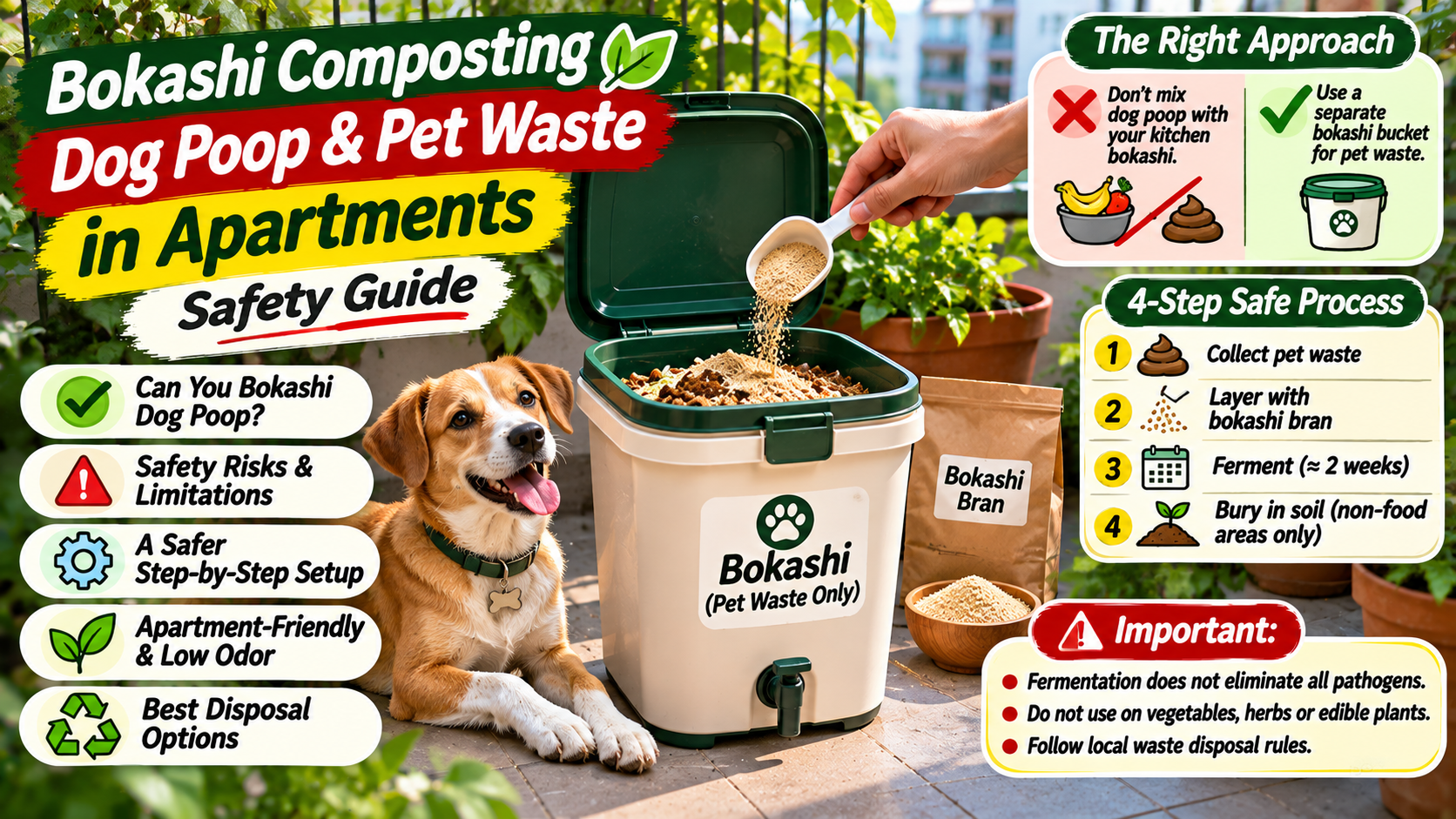
Bokashi Composting Dog Poop in Apartments: Safety Guide
Apartment composting · Pet waste safety
Bokashi Composting in an Apartment: Can You Process Dog Poop Safely?
Bokashi can help manage many kitchen scraps in a small home, but dog waste is a different category. Learn why it should stay out of your regular food-scrap bucket, what the real risks are, and which apartment-friendly disposal options are safer.
Can you bokashi dog poop in an apartment?
For an ordinary household bokashi bucket, the safest answer is no. Standard bokashi systems are designed to ferment kitchen food waste in a sealed container with a microbial bran or spray. Dog faeces can contain organisms that cause illness, so adding it to a food-scrap system creates a contamination risk and makes the finished material unsuitable for normal garden use.
Some specialist bokashi suppliers discuss using a separate, dedicated system for pet droppings. One supplier explicitly warns against applying that fermented material to vegetable gardens because organisms from the faeces may remain a concern. Redland City Council also lists dog and cat excrement among materials not to put in its household bokashi process. These points are important: product-specific pet-waste fermentation is not the same as proving the waste has been sanitised.
Why dog waste needs separate handling
Dog faeces are not interchangeable with vegetable peels or coffee grounds. Depending on the animal and its health, faeces may carry bacteria and intestinal parasites. The risk is not always visible: waste can look and smell different after fermentation while still requiring careful handling.
- Pathogens: dog waste can contain bacteria such as E. coli and Salmonella; some studies have also detected Campylobacter.
- Parasites: dog faeces may contain parasite stages, including roundworm eggs, which cannot be identified by looking at the waste.
- Cross-contamination: scoops, gloves, bin taps, floors, and hands can transfer contamination to kitchen equipment or edible plants if systems are shared.
- Apartment exposure: leaks or spills in a small indoor space can contaminate floors, drains, pet areas, and surfaces used by children.
A safer apartment plan for dog waste
If you live in an apartment and want a low-mess routine, the practical solution is to separate pet waste at source and use a sealed collection method that follows your local waste rules. Keep the pet-waste stream completely separate from food scraps, worm bins, and finished compost.
Pick up promptly
Use a dedicated scoop or bag. Avoid leaving waste on balconies, shared paths, lawns, or near storm drains. Do not use kitchen utensils or gardening tools that are also used for food crops.
Contain it in a dedicated sealed caddy
Use a leak-resistant, lidded container reserved only for pet waste. Line it if your local authority permits the liner, keep it out of food-preparation areas, and empty it regularly so waste does not accumulate indoors.
Use an approved disposal route
Follow your municipality, building management, or waste contractor’s rules. This may mean a designated pet-waste bin or bagged residual waste. Do not flush dog waste or bags unless your local sewer utility specifically says it is permitted; never assume a septic system can accept it.
Clean the equipment separately
Wash the scoop and container in a designated utility area, not in a food sink. Follow the cleaner label, avoid mixing cleaning chemicals, and let everything dry before reuse.
Apartment pet-waste options compared
| Option | Apartment suitability | Safety notes |
|---|---|---|
| Bag and place in approved residual-waste bin | Usually the most straightforward | Follow local bagging and collection rules; secure the bag against leaks. |
| Dedicated sealed pet-waste caddy before collection | Useful for short-term storage | Keep separate from kitchen waste; empty and clean regularly. |
| Specialist pet-waste collection service | Useful where available | Ask where waste goes and whether the operator is authorised to process it. |
| Ordinary kitchen bokashi bucket | Not recommended | Do not mix dog faeces with food scraps or use the resulting material on edible plants. |
| Home worm bin or normal compost bin | Not recommended | Common home systems are not validated to reliably sanitise pet waste. |
| Balcony planter or indoor pot burial | Not recommended | Small pots do not provide a controlled treatment process and can expose people or pets. |
What about a dedicated pet-waste bokashi system?
A few specialist suppliers market separate bokashi products for pet waste. If you are considering one, treat it as a waste-management product—not as a way to make safe compost for food gardening. Read the exact product instructions, confirm the intended end use, and check local disposal rules before buying.
At minimum, a dedicated system should never share a bucket, tap, scoop, bran container, gloves, or storage area with your kitchen bokashi. Keep it securely closed and inaccessible to children and animals. If the supplier’s directions involve burying fermented waste, that requires suitable land and must be permitted locally; it is generally not a practical option for a balcony-only home.
What does recent research say about composting dog waste?
Research is developing, and it is worth describing it accurately. A 2026 study in Waste Management examined dog faeces in controlled home-composting trials. It reported that some stable composts produced after long processing periods—seven to fifteen months in pilot trials and twelve months in a household-scale trial—met the sanitation criteria assessed by the researchers. One seven-month pilot did not meet the same bacterial criteria, while a fifteen-month pilot and the household trial had no detectable target bacterial pathogens.
That is interesting evidence about specific, managed composting trials. It is not a test of a standard bokashi bucket, not evidence that a short fermentation cycle disinfects faeces, and not a reason to improvise a pet-waste compost system on an apartment balcony. The authors emphasised compost stability and sufficient processing, not a quick treatment.
Older extension guidance remains cautious for ordinary household piles. Iowa State advises against adding dog or cat faeces to a typical compost pile because pathogens may survive. The U.S. EPA’s home-composting guide also lists pet waste among materials to keep out of a backyard compost pile. Specialised dog-waste compost recipes are a separate system, with monitoring, aeration, curing, and restricted end uses—not a small sealed bokashi bucket.
Pet-waste hygiene checklist for small homes
- Keep pet-waste containers physically separate from the kitchen bokashi bucket and food-preparation surfaces.
- Wear disposable or washable gloves when handling faeces; wash hands thoroughly with soap and water afterwards.
- Use a dedicated scoop and cleaning cloth. Do not use them for kitchen or gardening tasks.
- Clean spills promptly using a product labelled for the surface and task. Never mix bleach with acids, ammonia, or other cleaners.
- Keep waste and cleaning products inaccessible to children, pets, and visitors.
- Ask your veterinarian about routine parasite prevention and faecal testing appropriate to your dog and location.
- Check your building rules and local council waste instructions; apartment and municipal requirements vary.
How to keep your regular apartment bokashi system safe
You can still use bokashi for its intended purpose: fermenting household food scraps. Use a clearly labelled food-scrap bucket, follow the bokashi bran or spray instructions, drain liquid as directed by the system, and keep the lid and tap clean. Do not use the food-scrap bucket for nappies, pet faeces, litter, or other sanitary waste.
If you want a broader introduction, keep your food-waste routine focused on fruit and vegetable scraps, coffee grounds, bread, and other items accepted by your bokashi system. Always check the manufacturer’s accepted-material list and your local composting programme’s rules.
Frequently asked questions
Can I put dog poop in my normal bokashi bucket?
No. Keep dog faeces out of the bucket used for kitchen scraps. Household bokashi fermentation is not a validated pathogen treatment, and mixing pet waste with food-waste output creates avoidable contamination risks.
Does bokashi fermentation kill parasites in dog poop?
Do not assume it does. Fermentation can change the material and reduce odour, but that is not proof that parasite eggs or all disease-causing organisms have been destroyed.
Can fermented dog poop be used for vegetables?
No. Do not use fermented dog waste on food crops, herbs, fruit, or edible container gardens. A supplier of specialist pet-waste bokashi also warns against vegetable-garden use.
Can I use a separate bokashi bucket just for dog waste?
Some specialist products are marketed for this purpose, but a dedicated bucket does not automatically sanitise the waste. Follow only the product’s exact instructions, keep it separate from kitchen composting, and do not use the output on edible plants.
Can I bury bokashi-treated dog waste in a balcony planter?
No. A small planter is not a controlled treatment site and may expose people or pets to pathogens. Do not bury pet waste in balcony pots or indoor planters.
Can I add dog poop to a worm farm?
Do not add it to a normal household vermicompost bin. Worm bins are not designed or validated to reliably sanitise pet faeces.
Is a compostable dog-poop bag safe for my home compost?
Not automatically. “Compostable” often refers to specific industrial or commercial conditions. Check whether the receiving facility accepts that exact bag and pet waste; do not assume it will break down in a home bin.
What is the easiest safe option for an apartment?
For most apartment households, promptly bagging the waste, temporarily storing it in a dedicated leak-resistant sealed caddy, and placing it in the locally approved waste stream is the simplest route.
- Redland City Council – Composting and bokashi instructions (lists dog and cat excrement as unsuitable for its household bokashi bin).
- Bokashi Cycle – Frequently asked questions (supplier guidance on separate pet-waste use and avoiding vegetable gardens).
- Iowa State University Extension – Can dog or cat feces be placed in a compost pile?
- U.S. Environmental Protection Agency – Composting at Home (materials to avoid in ordinary backyard composting).
- USDA NRCS / Fairbanks Soil and Water Conservation District – Composting Dog Waste (specialised outdoor process, monitoring, curing, and use limitations).
- Bryson et al. (2026) – Sanitisation of dog faeces through home composting, Waste Management.
This article provides general waste-handling and gardening information, not veterinary, public-health, or local legal advice. Disposal rules vary by municipality and building. When in doubt, follow your local authority’s instructions and keep pet waste out of food-growing systems.