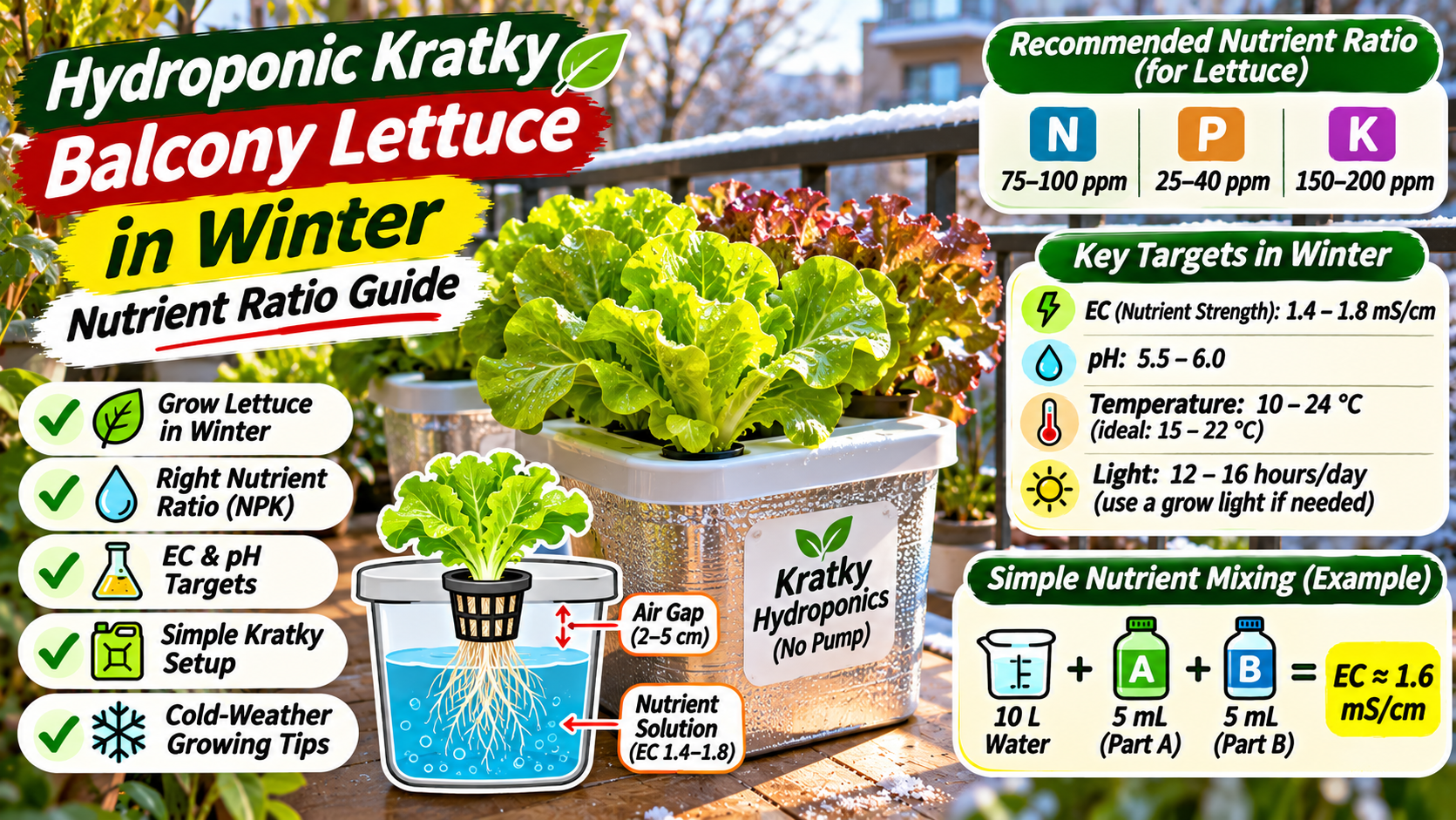
Kratky Balcony Lettuce in Winter: Nutrient Ratio & EC
Hydroponic Kratky Balcony Lettuce in Winter: Nutrient Ratio, EC & pH
Use a balanced lettuce nutrient solution, protect the reservoir from temperature swings, and preserve the Kratky air gap for healthier winter greens—even when you only have a small balcony.
Growing lettuce with the Kratky method is a simple way to produce fresh leaves without an air pump or electricity for water circulation. A jar, bucket or opaque storage container holds the nutrient solution while the roots develop down into it. In winter, however, cooler temperatures and shorter days slow growth, which makes nutrient strength and light management especially important.
The question most balcony growers ask is: What nutrient ratio should I use for Kratky lettuce in winter? There is no single winter-only NPK ratio that suits every lettuce variety, water supply and climate. A more reliable approach is to use a complete hydroponic nutrient formulated for leafy greens, follow its mixing directions, and check the final electrical conductivity (EC) and pH.
For established hydroponic lettuce, a useful reference range is EC 1.4–1.8 mS/cm and pH around 5.5–6.0. Seedlings need a gentler solution; Purdue’s hydroponic lettuce guide lists about 0.5 mS/cm during germination. In cold, low-light conditions, do not compensate for slow growth by automatically adding extra fertilizer.
1. What nutrient ratio should you use for winter Kratky lettuce?
Use a complete hydroponic nutrient for lettuce or leafy greens that supplies nitrogen, phosphorus, potassium, calcium, magnesium, sulfur and trace elements. The label’s N-P-K numbers are not the whole formula: calcium, magnesium, iron and micronutrients matter too.
Rather than chasing one fixed N-P-K ratio, manage the solution by its EC. EC measures the total concentration of dissolved salts; it does not tell you which individual nutrient is present or whether the formula is balanced. Two fertilizers can show the same EC while supplying different nutrient profiles.
Start with a dilute, seedling-appropriate solution. Purdue’s lettuce production material gives approximately 0.5 mS/cm for the germination phase.
University of Florida guidance lists 1.4–1.8 mS/cm as an ideal EC range for hydroponic lettuce.
Purdue’s hydroponic lettuce guide gives a nitrogen concentration of 75–100 ppm. Follow the formulation and product instructions rather than adding a separate nitrogen source blindly.
Winter growth may be slower because of temperature and light. A stronger solution does not make a cold, light-starved plant grow faster.
One simple Kratky example
The University of Saskatchewan describes a low-cost, modified Kratky lettuce setup using 1 g of water-soluble 20-20-20 fertilizer per 1 L of water. This is a specific educational example, not a universal recipe for every 20-20-20 product. Fertilizer formulations differ, and some general-purpose plant foods may not supply the ideal balance for hydroponic food crops.
For more predictable results, use a complete hydroponic lettuce nutrient and follow its label. If it is a two-part A/B product, add each part to water separately in the order stated by the manufacturer. Do not mix concentrated A and B solutions together: calcium can react with concentrated sulfates or phosphates and form precipitates.
2. Winter EC and pH targets
| Growing stage | EC reference | pH reference | What to do |
|---|---|---|---|
| Germination / very young seedling | About 0.5 mS/cm in Purdue guidance | Follow nutrient maker’s seedling guidance | Keep the plug moist; avoid a strong feed before roots establish. |
| Established leaf lettuce | 1.4–1.8 mS/cm (UF/IFAS reference) | 5.5–6.0 is a common working target | Use a complete lettuce formula and check EC after mixing. |
| Cold or low-light balcony | Start conservatively within the product’s lettuce range; adjust only after measuring | Keep within the product / crop range | Slow growth is often environmental, not a signal to add more fertilizer. |
Important: EC targets differ among nutrient brands, source water, meters and production systems. If your tap water already has a high EC, the fertilizer dose must be considered alongside that starting value. Calibrate your EC and pH meters and use the same units throughout.
3. How to mix a Kratky lettuce nutrient solution
- Measure your water first. Use clean water suitable for growing edible crops. Record its starting EC if you have a meter; hard or mineral-rich water can affect the final reading.
- Read the nutrient label. Check whether the product is a single-part or A/B hydroponic formula and whether the dose is intended for seedlings or mature plants.
- Add nutrients to the water, not concentrate to concentrate. Mix each part into the full volume of water as directed. Stir until dissolved before adding the next part.
- Measure the final EC. Compare it with the stage-appropriate range. If it is too high, dilute with water; if too low, adjust only according to the nutrient maker’s directions.
- Check pH last. Adjust gradually with a hydroponic pH product if needed. Never mix pH adjusters directly with concentrated fertilizer.
4. Nutrient-dose calculator for your reservoir
This calculator scales the dose printed on your fertilizer label to the amount of water in your Kratky container. It does not invent a new nutrient ratio; it helps you measure the manufacturer’s recipe accurately.
Calculate your nutrient amount
Use a reduced label strength only when the product manufacturer recommends it for seedlings or your measured EC calls for dilution. For established lettuce, use the appropriate mature-crop instructions and verify with an EC meter.
5. Set up the Kratky reservoir correctly
The Kratky method works because the nutrient level gradually falls as the plant drinks. Roots that reach the solution absorb water and nutrients, while roots exposed to the humid air space take up oxygen. The air gap is a key part of the method.
Simplified Kratky container: as the solution level drops, part of the root system remains exposed to humid air. Keep the reservoir shaded from direct light.
- Start with the seedling plug just touching the solution. This allows new roots to find the nutrient water.
- Let the level fall as roots develop. The University of Saskatchewan’s modified Kratky instructions describe keeping about a 1–2 cm air space between the solution and the bottom of the seedling plug once roots have emerged.
- Do not keep topping the container to the original level. Re-filling all the way can submerge the air roots and remove the oxygen zone.
- Block light from the reservoir. Use an opaque bucket or cover a clear jar with an opaque sleeve; light encourages algae growth.
6. Balcony winter care: temperature, light and wind
Lettuce is a cool-season crop, but cold conditions still slow its growth. A recent University of Kentucky controlled-environment profile describes daytime production temperatures up to about 24°C and night temperatures around 18°C, while noting that lettuce may tolerate cooler conditions—about 15°C days and 10°C nights—at the cost of slower growth. Avoid freezing the nutrient solution or exposing young plants to harsh wind.
A simple winter balcony routine
| How often | Check |
|---|---|
| At setup | Mix fresh nutrient solution, check EC and pH, shade the reservoir and confirm the seedling plug can reach the solution. |
| Every few days | Look at leaf colour, root appearance, reservoir level, pests and exposure to wind or frost. |
| Weekly | Measure EC and pH if you have meters. Avoid adding fertilizer just because the plant looks slow; first check light and temperature. |
| At harvest | Clean and sanitize the container and net cup before starting the next crop. Prepare fresh solution rather than carrying old solution into a new plant cycle. |
7. Common winter Kratky lettuce problems
| Symptom | Possible reason | What to check |
|---|---|---|
| Very slow growth | Low temperature, insufficient light or weak nutrient solution | Measure temperature and EC; assess daily sunlight before increasing fertilizer. |
| Brown or slimy roots | Low oxygen, warm/stagnant solution, light leakage or root disease | Check the air gap, reservoir cleanliness and temperature. Remove severely rotted plants. |
| Leaf-edge burn | Calcium transport issue, high humidity, heat or unbalanced solution | Check airflow, temperature, pH and complete nutrient balance; do not add calcium blindly. |
| Algae in the jar | Light entering the nutrient solution | Use an opaque container or cover; clean the container between crops. |
| Leaves pale or yellow | Low nutrients, pH-related lockout, poor roots or insufficient light | Measure EC and pH, inspect roots and check light before changing the formula. |
| Solution disappears quickly | Large plant, warm/windy balcony or small reservoir | Use a larger opaque container for the next crop; avoid disrupting the established air-root zone when managing the current one. |
8. Best practical setup for a small balcony
- Choose an open-leaf lettuce variety. Compact leaf types are easier to manage than large, tight-heading varieties in a small Kratky container.
- Use an opaque, stable reservoir. A food-safe bucket or container with a lid is more stable than a narrow, easily tipped jar outdoors.
- Use one plant per opening. Give the leaves room for airflow and keep the container secure against wind.
- Mix a complete nutrient solution. Follow the product label, check EC and adjust pH after mixing.
- Keep the air gap. Allow the water level to fall as roots develop rather than constantly filling the reservoir to the top.
- Harvest outer leaves or the whole plant. Start a new seedling every 1–2 weeks for a steadier supply.
Frequently asked questions
What is the best nutrient ratio for Kratky lettuce in winter?
There is no single winter-only N-P-K ratio. Use a complete hydroponic nutrient formulated for lettuce or leafy greens, follow the label and manage the final solution using EC. A reference EC for established lettuce is 1.4–1.8 mS/cm, while young seedlings need a much weaker solution.
Should I increase nutrients when lettuce grows slowly in winter?
No—not without measuring. Low temperature and low light commonly slow lettuce growth. Extra fertilizer can raise EC and stress roots without correcting the environmental problem.
What pH should Kratky lettuce water be?
A practical working target is around pH 5.5–6.0. Some guides give a wider range, so also follow your nutrient manufacturer’s crop instructions and test with a calibrated meter.
Can I use 20-20-20 fertilizer in a Kratky jar?
A University of Saskatchewan modified Kratky demonstration uses 1 g/L of a water-soluble 20-20-20 fertilizer. However, not every 20-20-20 product is formulated for hydroponics or provides the same micronutrients. A complete hydroponic lettuce formula is more predictable.
How much water does one Kratky lettuce plant need?
It depends on the lettuce type, container, plant size and growing conditions. The University of Saskatchewan home method demonstrates one lettuce in a 1 L container, but a larger reservoir gives more buffer outdoors and may be more convenient for a full-size plant.
Should I refill my Kratky reservoir in winter?
Do not automatically refill it to the top. The falling solution level creates an air space for oxygen uptake. If you need to add water, avoid submerging the air roots; monitor the level and follow the requirements of your specific Kratky container and crop stage.
Can lettuce survive on a balcony at 10°C?
Lettuce can tolerate cool conditions, and a University of Kentucky profile notes that it may grow at around 10°C overnight and 15°C during the day, but growth will be slower. Protect the reservoir and seedlings from freezing and harsh wind.
Do I need an air pump for the Kratky method?
No. Kratky is a passive, non-circulating method. The air gap that forms as the solution level drops supplies oxygen to the roots exposed above the solution.
Final thoughts
Successful winter Kratky lettuce is less about finding a secret fertilizer ratio and more about keeping the nutrient solution balanced while protecting the plant from cold, low light and wind. Begin with a complete lettuce nutrient, measure EC and pH, keep the reservoir dark, and preserve the air gap that makes the Kratky method work.
For a small balcony, start with one or two compact lettuce plants, record your EC and pH readings, and adjust based on what the plants and measurements tell you. That simple routine is more reliable than repeatedly adding fertilizer whenever growth slows.
Sources and further reading
- University of Saskatchewan – Hydroponic Lettuce. Includes a modified Kratky home method, 1 g/L example nutrient solution and a 1–2 cm air gap after roots emerge.
- Purdue University – Hydroponic Lettuce Production. Includes seedling EC, nitrogen and pH guidance for lettuce.
- University of Florida IFAS – Growing Lettuce in Small Hydroponic Systems. Covers nutrient EC management and pH for home hydroponics.
- University of Kentucky – Hydroponic Lettuce Production in Controlled Environments. Covers lettuce temperature and light conditions, including cooler growing conditions.
This article is for educational gardening purposes. Nutrient requirements vary with cultivar, water quality, fertilizer formulation, light and temperature. Product labels and measured EC/pH should take priority over generic mixing recipes.