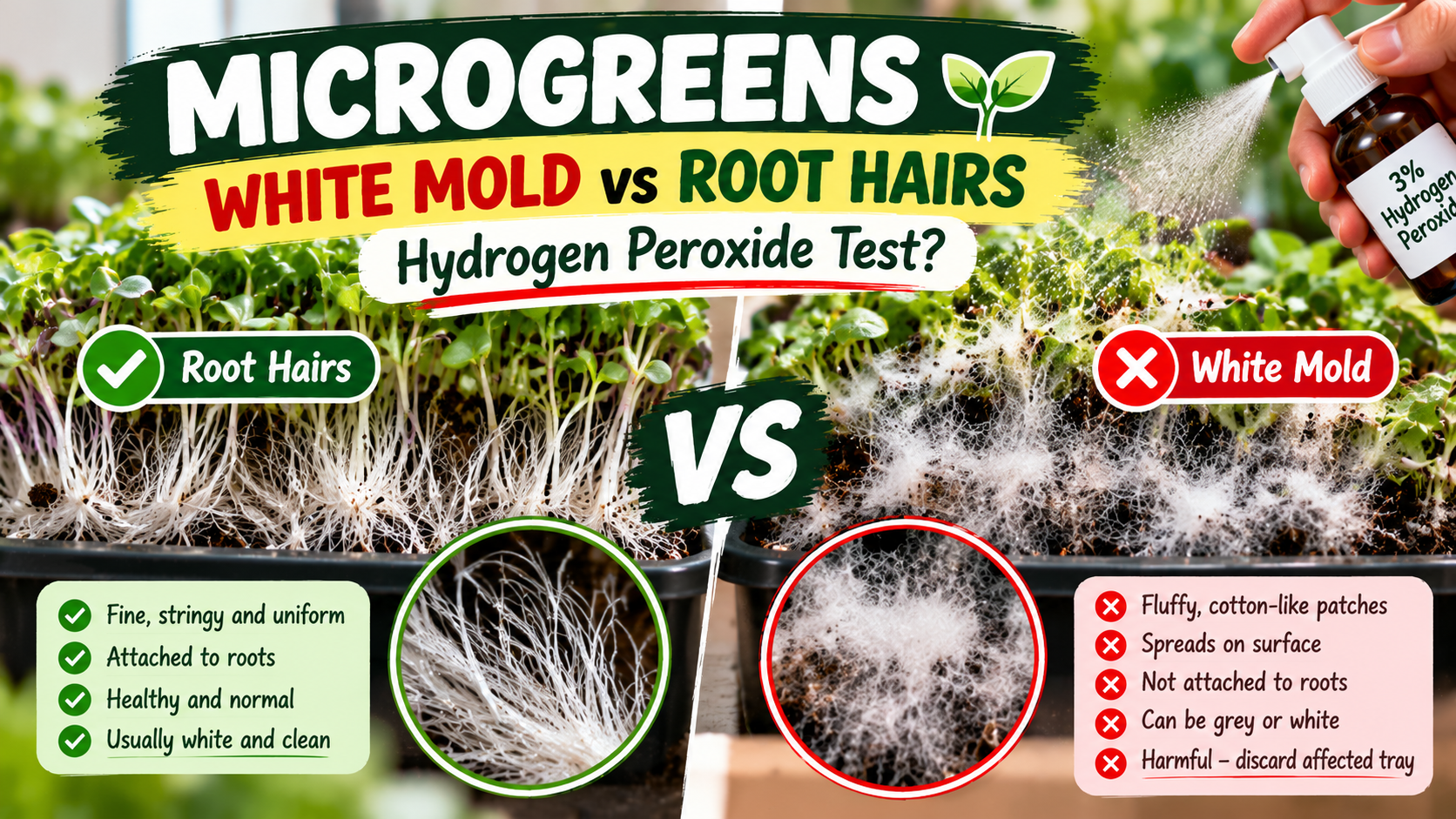
Microgreens White Mold vs Root Hairs: Peroxide Test?
Microgreens White Mold vs Root Hairs: Does the Hydrogen Peroxide Test Work?
White fuzz around young microgreens can be normal root hairs—or a sign of unwanted fungal growth. Learn the visible clues, what a light water-mist check can tell you, and why hydrogen peroxide should not be treated as a food-safety test.
Seeing white fuzz on a tray of microgreens can be alarming, especially when you are growing food indoors. The first step is not to spray a chemical. Look at where the fuzz is attached, whether it bridges between seedlings, and whether the plants look healthy.
Microgreens white mold vs root hairs: how to tell the difference
Root hairs are tiny extensions produced by young plant roots. They help the plant absorb water and nutrients, so a white halo close to a root can be a normal part of germination. Mold is fungal growth; it may form threads or a mat that spreads across the medium or connects nearby seeds and stems. Appearance alone is not always conclusive.
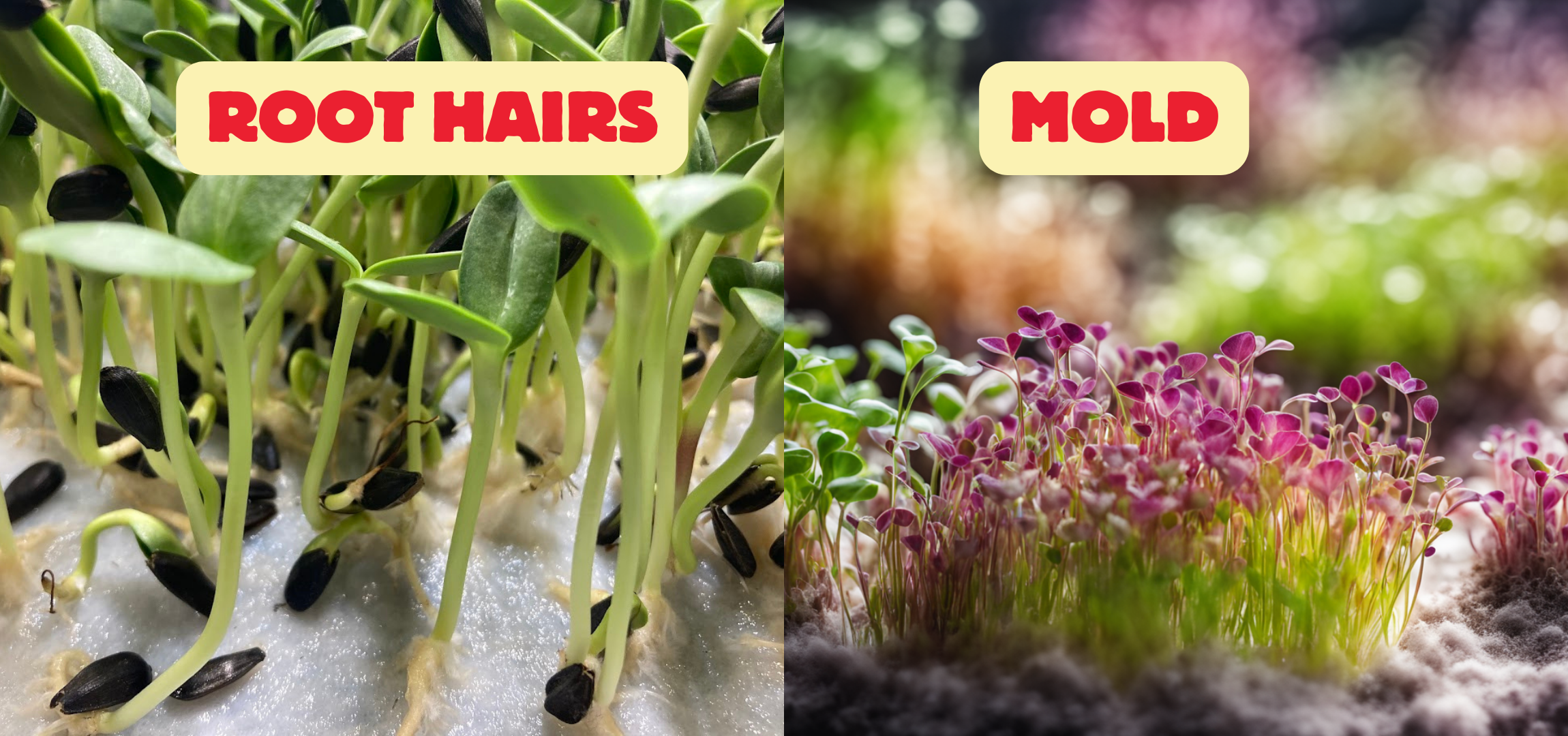
Fine fuzz attached to roots
- Forms a fairly even halo close to individual roots.
- Does not form long bridges over bare medium between plants.
- Seedlings otherwise appear firm and normally colored.
- Usually has no musty or sour odor.
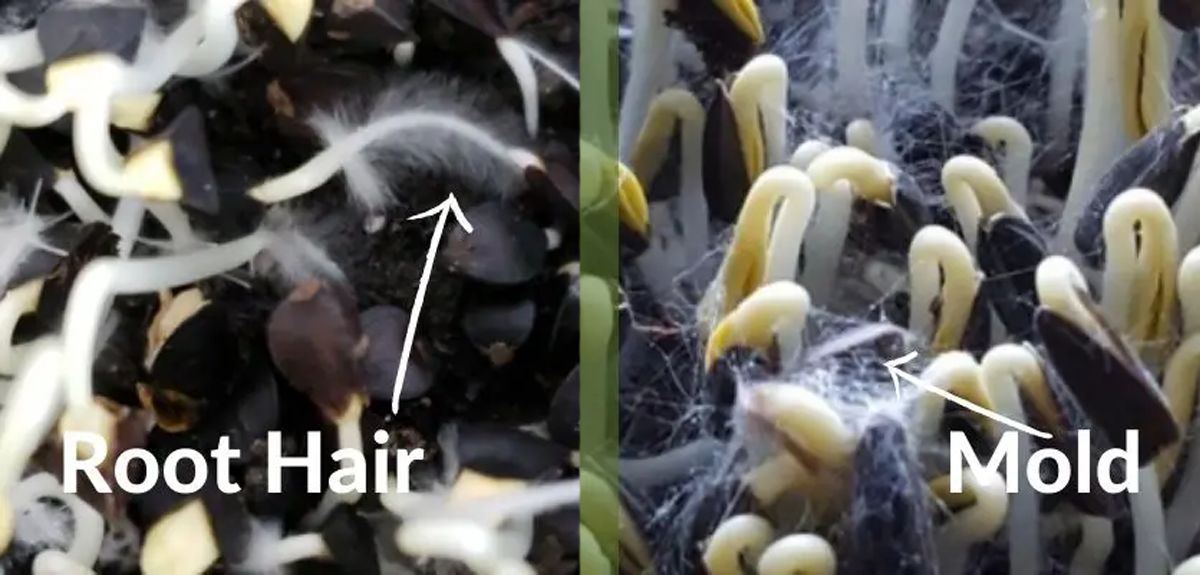
Irregular webbing or spreading patches
- Crosses from one seed, stem or surface to another.
- Spreads across the medium rather than staying at the roots.
- May accompany a musty smell, slime or decaying seedlings.
- Seedlings may be weak, water-soaked or collapsing.
Image note: the examples above are for visual comparison only. Check image reuse permissions before publishing; replace with your own or licensed photos if needed.
The water-mist check: a safer first look
Many growers use a light mist as a quick visual clue. Root hairs often lie flat against the root when wet and become less visible; fungal webbing may remain more apparent. This is a heuristic, not a validated diagnosis, and it cannot rule out pathogens or certify the crop as safe to eat.
- Inspect before touching. Look for healthy, upright seedlings and note whether the fuzz is confined to individual roots or spans gaps between plants.
- Mist one small area lightly with clean water. Do not soak the tray or spray forcefully enough to spread material around.
- Observe the change. Fuzz that flattens closely onto individual roots is more consistent with root hairs. A web-like mat that bridges seeds or medium remains concerning.
- Check the rest of the tray without rubbing the fuzz. Avoid touching the suspect area and then handling healthy trays, tools or harvested greens.
- Stop if uncertain. A mist response is not proof of identity or food safety. If you still suspect mold, do not taste the crop.
Does the hydrogen peroxide test work on microgreens?
No—hydrogen peroxide is not a reliable test for distinguishing white mold from normal root hairs. There is no dependable household peroxide reaction that identifies the organism or proves a tray is safe. Foaming, fading or a change in appearance is not a validated way to tell root hairs from fungal growth.
Some home-growing guides mention diluted hydrogen peroxide as an optional mold-management measure, but that does not make it a diagnostic test or a food-safety treatment. Concentration, crop stage and application method matter, and spraying edible microgreens with a chemical should not be used as a shortcut to save a questionable crop. Do not improvise a peroxide dilution or combine it with other cleaners.
When should you throw away a microgreens tray?
Choose the cautious option if you see spreading web-like growth, a musty or sour odor, slime, soft or water-soaked stems, seedlings pinched at the growing-medium line, or widespread collapse. Do not cut out just the visible patch and eat the rest: contamination may extend beyond what you can see.
- Keep a suspect tray away from other growing trays.
- Do not sniff closely, rub or brush visible growth.
- Discard the crop and its growing medium in a sealed bag; do not reuse the contaminated medium for another edible tray.
- Wash hands and clean the tray and tools thoroughly before reuse, following appropriate food-contact cleaning directions.
- Do not taste a questionable crop to check whether it is safe.
People who are pregnant, very young, older, or immunocompromised should be especially cautious with raw or potentially contaminated produce. If the fuzz is ambiguous, the safest choice is not to eat it.
How to prevent mold on future microgreens trays
1. Start with clean trays and tools
Remove old roots and growing medium, then clean containers and equipment between crops. Use clean water and a fresh, suitable growing medium. Keep hands, scissors and spray bottles clean.
2. Avoid waterlogged conditions
Keep the growing medium evenly moist, not saturated. Ensure trays drain properly and remove standing water. Follow crop-specific watering guidance: different seed varieties and growing systems do not all need the same amount of water.
3. Improve airflow and light after germination
Once seedlings have germinated, provide suitable light and gentle air movement. Avoid trapping persistently humid air around the canopy. Do not use a fan so strong that it dries seedlings or blows debris between trays.
4. Sow evenly and remove plant debris
Follow seed-pack instructions for spacing and seeding density. Thick clumps, damaged seeds and dead plant material can keep areas wet and make inspection harder. Remove debris with clean tools, without disturbing a suspicious patch.
5. Monitor each tray
Check trays daily, particularly during germination. If one tray develops suspicious growth, isolate it and review watering, drainage, cleaning and airflow before starting the next batch.
Frequently asked questions
No. A household peroxide reaction is not a validated diagnostic test. Do not use it to decide that a suspect crop is safe to eat.
They often flatten against the root and become less visible when wet, then show again as they dry. This is only a clue; it cannot conclusively identify growth or establish food safety.
No. Fine white hairs attached closely to newly formed roots are often normal root hairs. Spread, bridging, smell, slime and the condition of the seedlings matter too.
Do not try to rescue a visibly moldy or questionable tray by rinsing it. Washing does not reliably make contaminated produce safe and may spread contamination. Discard the suspect crop.
Do not eat the crop. Isolate the tray and seek advice from a qualified plant diagnostic service if identification matters. For home food use, discarding an ambiguous tray is the safer choice.
Not sure what is growing in your tray?
Use the root-zone pattern and plant health as your first clues. If the growth bridges between plants, smells unpleasant, becomes slimy or remains ambiguous, play it safe and discard the crop.
Sources and further reading
- Purdue University Extension: Grow Microgreens at Home — root hairs are normal; discusses hygiene and optional mold-management approaches.
- Sustainable Gardening Australia: Growing Microgreens (PDF) — practical visual notes comparing root hairs and mold.
- Penn State Extension: Ensuring Food Safety in Microgreens Production — sanitation and safe handling considerations.
- Purdue Extension FoodLink: Microgreens — handling and washing guidance for microgreens.
Editorial note: This guide is for general educational use, not laboratory diagnosis. Neither the water-mist check nor peroxide can prove a crop is free of harmful contamination.